Beyond the Ceiling: How Rooftops Can Redefine Urban Retail

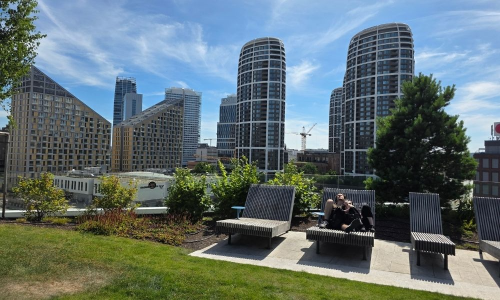
Forum Aveiro in Aveiro, Nivy Centrum in Bratislava, La Vache Noire in Arceuil – Paris, and Galeria Polnocna in Warsaw, just a few examples all having in common that their roofs are part of the attractiveness of these schemes. With publicly accessible green areas, play and sports rounds, and spaces for events, these roofs are much more than a roof, these add in fact an extra floor to the shopping centre. At PAKT, a mixed-use project in a former industrial complex in Antwerp, the roof is in fact almost the ‘raison d'etre' of the scheme, accommodating Europe's largest urban roof farm.
The idea of using the roof as attraction is not new. It is said that famous historic department stores such as Selfridges in London had in some cases mini-zoos and parks on their roofs. There are a few early examples of shopping centres with publicly accessible roofs. At Westend Center in Budapest, developer TrizecHahn responded to the lack of green in the wider area. Forum Aveiro, developed by Multi Development, the architects of T+T Design took advantage of the local geomorphology by creating a roof park. But, in general, roofs did not receive a lot of attention from architects and concept designers until not so long ago. The roof was simply the closing layer of a shopping center often covered with grind or gravel. A non-accessible layer providing protection against the weather, often with light domes to let daylight into the mall, and providing space for all kinds of technical installations. With sustainability becoming a priority in project development from a point of view of climate control, rainwater management, and energy production, the roof started to receive more attention.
‘Building Green' the need for more sustainable development facilitated by accreditations such as BREEAM and LEED put the roof in another perspective. From rather a necessity, the roof became an opportunity, an opportunity to give an additional identity to a scheme: the roof as element in the visitor experience. Since then, the roof has been reinvented as public green space, as playground, as sports facility, and of course as point from which one can enjoy the view over the surrounding urban fabric.
Situated on a river side at the foot of a slope, making a connection with a neighbourhood on the slope was an additional challenge in the design process of Forum Aveiro, an inner-city shopping and residential scheme inaugurated in 1999. The solution was a public accessible roof park with view over the river and the old town as well as into the shopping centre. In those years, sustainability was hardly a topic. But the roof park contributed to the quality of living in the surroundings and was a key element in the durable long-term performance of the centre.
Another example is La Vache Noire near Paris. The municipality and also the community signalled the need for a shopping centre as supply in the area was very limited. Local residents pointed out the need for public green as there was a lack of it. A compromise was found to position the centre underground with a park on top of it, surrounded by residences and some offices, resulting in a new attractive urban quarter. In Stockholm, URW Unibail Rodamco Westfield transformed the roof floor of the parking house at Taby Centrum in an accessible green roof with food trucks in 2019 when it renewed its Taby Centrum scheme.
One of the more recent examples is the newly developed Nivy shopping centre in Bratislava, a large shopping and mixed-use complex integrated with Slovakia's main bus station inaugurated in 2021. Its publicly accessible green roof is an additional anchor where people can meet, relax, play, and do sport. A 7,000 sqm park is free accessible to the public, and the roof is well frequented with nice weather. A well-designed open-air event space provides the main connection between the food court of te mall and the roof.
The roof of PAKT in Antwerp is a shining example of how leisure can be redefined not just as entertainment, but as active participation with the neighbourhood and education. Located in a former industrial site, PAKT integrates shared workspaces, sports, gastronomy and cultural programming with Europe's largest urban farm of almost 2,000 sqm on its rooftop. The urban farm was established by farmers who had difficulties finding agricultural land in densely populated Flandres and decided to change their approach and the local developer of PAKT, Immo Yaman, invited them to start a farm on the roof. The rooftop urban farm not only produces vegetables for its members and local use but also offer workshops, school education programs, and public events. This hybrid model creates a place-based identity, rooted in ecological and social value. The urban farm that started as experiment, has been so successful that it operates without any subsidies and the roof generates actually some rental income for the landlord.
However, bringing the roof to life comes at a cost. Creating a publicly accessible roof with green like grass and trees and active functions requires design skills and puts additional demands on construction quality, as the roof should be able to carry all this without leaking and other calamities. Also, it requires additional management skills. For instance, creating a garden is one, managing and maintaining it is two. And finally, it comes at a higher cost in terms of investment and CAPEX. A roof garden that falls into decay is a waste of capital and can harm the functioning and image of a given location.
The reinvention of the roof signals more than just a shift in retail and shopping centre concept strategy—it marks a broader reorientation in urban life. If done right, these projects do contribute to vibrant city centres and urban areas, offering social, educational, and ecological value. They have the potential to become the new hearts of towns and cities: Not malls in the old sense, but modern agora's where experience, sustainability, and social connection converge.
18 Ağustos 2025
683
*Dijital Network Alkaş (“DNA”), blog yazarı tarafından DNA'da paylaşılan içeriklerin doğruluğundan, geçerliliğinden, güncelliğinden ve telif hakları konusundaki iddialardan sorumlu değildir. Tüm hukuki ve cezai sorumluluk blog yazarına aittir.



Blog
14 Eylül 2026

Yapay Zekâ Çağında Yeni Rekabet Avantajı Bilmek Değil; Harekete Geçmek
Tunç Berkman
TBS Investment & Management
Blog
7 Eylül 2026

BETON VADİLERİNİN GÖRÜNMEZ TEHLİKESİ: KENTSEL ISI ADALARI
Buğra Esen (MRICS)
Gayrimenkul Değerleme Uzmanı, Akademisyen


Blog
13 Ağustos 2026
DİJİTAL DÖNÜŞÜM, DİJİTAL MESAİ, DİJİTAL YORGUNLUK
Buğra Esen (MRICS)
Gayrimenkul Değerleme Uzmanı, Akademisyen

Blog
16 Temmuz 2026
Sahiplik Bitiyor, İlişki Ekonomisi Büyüyor: Yeni Ekonominin Görünmeyen İş Modeli
Tunç Berkman
TBS Investment & Management
İlgili Yazılar...

Blog
22 Kasım 2022
Çevresel, Sosyal, Kurumsal Yönetişim (ESG), Sürdürülebilirlik, İklim Değişi...
Ersun Bayraktaroğlu
Yeminli Mali Müşavir, Danışman
SÜRDÜRÜLEBİLİRLİK

Blog
19 Eylül 2022
Nefes Alıp Veren Bir Deneyim “42 Maslak”
Erol Özmandıracı
Bay İnşaat, Yönetim Kurulu Üyesi
AVM
DİĞER
C-LEVEL
TİCARİ GAYRİMENKUL
MAĞAZACILIK


Blog
11 Ağustos 2022
Sürdürülebilir Bir Yaşam Nedir?
Özlem Dalga
İletişim Uzmanı, Gazeteci, Sunucu, Ekonomist, Proje Yöneticisi
SÜRDÜRÜLEBİLİRLİK
Blog
24 Eylül 2021
2021 Sonrasında Tüm Sektörleri Etkileyecek 7 Faktör
Dr. Fatoş Karahasan
Bilgi Üniversitesi Öğretim Görevlisi Gazeteci/ Yazar
SÜRDÜRÜLEBİLİRLİK
TEKNOLOJİ


Blog
2 Ocak 2023
COP27’den İklim Değişikliği Eğitimi Konusunda Kritik Karar: İklimi Güçlendi...
Bahar Özay
UN SDSN Türkiye Koordinatörü
SÜRDÜRÜLEBİLİRLİK


Rapor
31 Mart 2023
2023’ün Perakende Trendleri Raporu Yayımlandı - Mastercard Global Ekonomi E...
DNA Editör
Editör
PERAKENDE
FİNANS / EKONOMİ
C-LEVEL
MÜŞTERİ DENEYİMİ

İletişim
organizasyon@alkas.com.tr
© Digital Network Alkaş | 2026